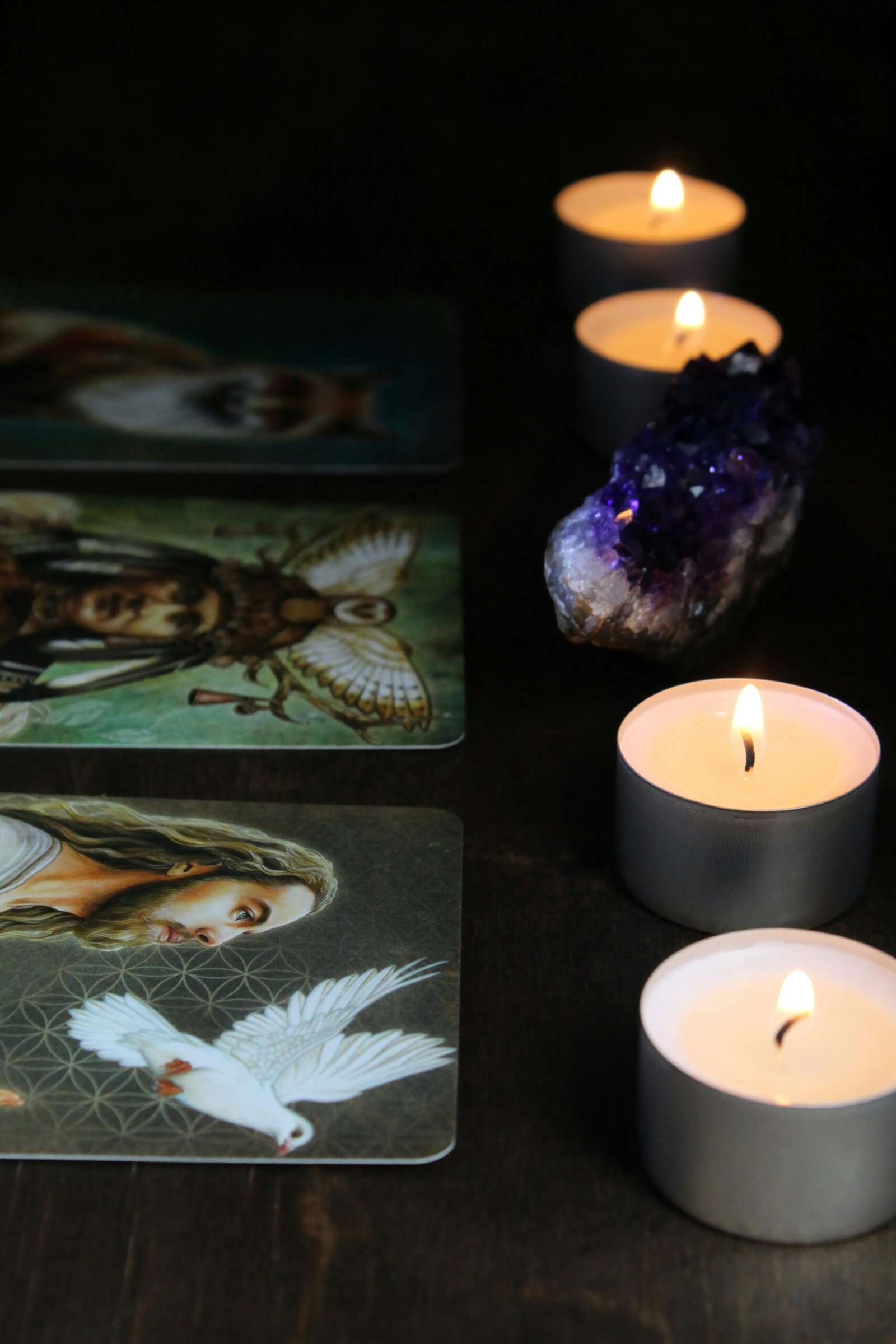
Most people assume tarot cards were invented for fortune-telling. The truth is far more interesting: tarot began as a card game in Renaissance Europe and only became a tool for divination centuries later. Understanding that journey explains both how the cards work and why they carry the symbols they do.
The 15th-Century Origins
The earliest known tarot decks appeared in northern Italy around the 1440s, created for aristocratic households. The Visconti-Sforza deck, the most famous survivor of that era, was commissioned for the ruling families of Milan — and it was designed to be played, not to predict the future. These early cards featured the four suits we still use — cups, pentacles, swords, and wands — alongside a set of illustrated trump cards that later became the Major Arcana.
The Leap from Game to Divination
The transformation began in the late 18th century, when occultists and mystical groups began attaching esoteric meanings to the cards. French occultist Jean-Baptiste Alliette (known as Etteilla) published some of the first card-reading systems, and the influential tarot scholar Antoine Court de Gébelin argued that the cards preserved hidden ancient knowledge. From that point, tarot was gradually adopted by fringe spiritual and occult communities, and its reputation as a divination tool took root.
What the 78 Cards Contain
A standard tarot deck holds 78 cards divided into two families: the Major Arcana and the Minor Arcana. The 22 Major Arcana cards — The Fool, The Magician, The High Priestess, The Empress, and so on — represent significant life events, spiritual lessons, and archetypal forces. The 56 Minor Arcana cards represent everyday events and practical concerns, structured into four suits, each with fourteen cards numbered from Ace to Ten plus four court cards.
- Wands — creativity, action, career drive
- Cups — emotions, relationships, intuition
- Swords — intellect, conflict, decisions
- Pentacles — money, work, material wellbeing
How a Reading Works: The Role of Synchronicity
At the heart of tarot practice sits the concept of synchronicity — the idea, popularised by psychologist Carl Jung, that meaningful coincidences are not truly random. When you shuffle a deck and draw cards, practitioners believe the cards that appear reflect the state of your inner world and current circumstances of the moment. The reader then connects those drawn cards to your question, turning abstract symbols into practical guidance.
Tarot is not fundamentally about predicting a fixed future. Rather, it is about unpacking layers — the habits, fears, hopes, and patterns that shape your decisions — so that you can make more aware choices going forward. That is why a good reading often feels like self-discovery as much as guidance.
Tarot in the Modern Age
Once looked down on as superstition, tarot today sits comfortably inside modern spirituality and the self-help movement. Millions use the cards for journaling, meditation, relationship insight, and career reflection. Its resurgence in popular culture has fueled a wave of diverse decks — from minimalist and inclusive decks to decks based on nature, pop culture, and psychology.
Whether you treat tarot as a spiritual practice, a psychological mirror, or simply a beautiful art form, its centuries-long evolution shows why it keeps capturing the imagination: it taps into something deeply human — our desire to understand ourselves, our choices, and the invisible patterns shaping our lives.
A Quick Timeline of Tarot’s Evolution
| Period | Milestone |
|---|---|
| c. 1440s | Earliest known tarot decks appear in northern Italy as playing cards |
| 1780s | Occultists begin attaching esoteric, divinatory meanings |
| 1909 | Rider-Waite-Smith deck publishes fully illustrated Minor Arcana |
| Mid-1900s | Carl Jung popularises synchronicity; tarot enters psychology |
| Today | Tarot is mainstream across spirituality, self-help, and pop culture |
Common Misconceptions, Debunked
- “Tarot predicts a fixed future.” It reflects tendencies and lessons, not unchangeable fate.
- “The Death card means something tragic.” It symbolises transformation and letting go of an old phase.
- “You must be psychic to read.” Reading is a learnable skill built on symbols, observation, and intuition.
- “Only certain people may touch your cards.” Anyone whose energy you trust can handle them; it’s personal preference.
Understanding these myths matters because how you approach the cards shapes what you receive from them. Readers who treat tarot as a mirror rather than a crystal ball tend to find it far more useful in real life, whether they are navigating career choices, relationships, or personal growth.
Why History Matters to Your Practice
Knowing the origin of the cards changes how you use them. When you understand that the Major Arcana began as courtly trump cards and that the suits mirror everyday medieval life, the symbols stop feeling arbitrary and start feeling logical. The Fool, the Hanged Man, the Empress — each is a snippet of Renaissance cosmology that still organises human experience today.
For a beginner, this historical context is practical, not just academic. It gives you a memorable framework for learning the meanings: instead of memorising 78 unrelated meanings, you learn that the deck is a journey (Major Arcana) taking place across four domains of life (Minor Arcana suits). Once that framework clicks, the cards begin to read almost intuitively.
Reading with Respect for a Living Tradition
As tarot grows more visible online, it is worth remembering the tradition is alive — practised by millions with genuine reverence, not just used as a social-media trend. Approaching the cards with respect (clean decks, clear intentions, ethical practice) honours that lineage and, most readers would agree, yields sharper, more honest readings.
Whichever door brought you to tarot — curiosity, personal growth, or spiritual connection — you are now part of a tradition nearly six centuries old. That is a remarkable thing to hold in a 78-card box on your shelf.
Related Stories
- A Beginner’s Guide to Tarot Card Reading: 7 Simple Steps to Read for Yourself
-
 Bad Bunny Astrology Profile: Zodiac Sign, Personality & Star Power
-
 Abhishek Sharma: Age, Net Worth, Career & Success Story (2026)
-
 🌟 31st December 2025 Predictions: What The Final Day of the Year Means For You, According to Astrology
-
 10 Common Mistakes Tarot Beginners Make and How to Avoid Them