

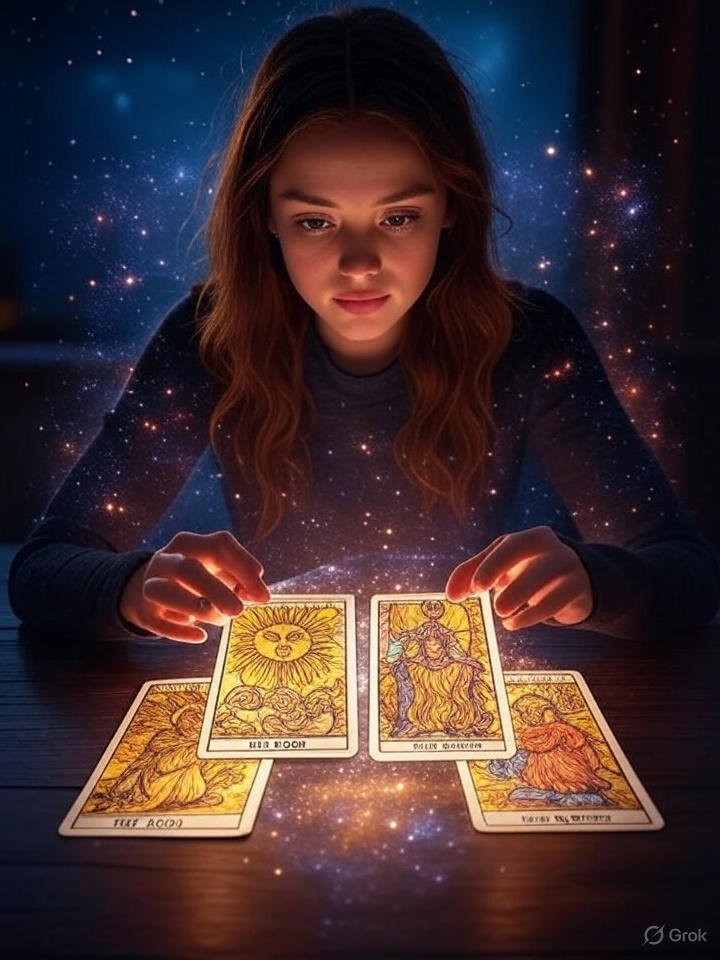
Using tarot cards for spiritual and verbal guidance is the best way for psychological and emotional support for ages. Tarot readings help people seek and find clarity in symbols that tell a story. This often allows them to have a new view of current problems and see things they were blind to before.
Tarot reading has some major psychosocial benefits that help in the process of self-reflection and growth. The interpretation of the cards also requires an individual to systematically look further into their thoughts, emotions, and motivations. This increased self-awareness also results in more educated & mindful choices which helps from an emotional perspective.
Tarot imagery and symbology can be wonderful for that, too. They will help you address the subconscious fears and unspoken concerns that keep bubbling up deep inside, allowing you to face your emotional state in a supportive, non-judgmental environment. This can be especially helpful for individuals suffering from anxiety, depression, or any other emotional issue because it provides an easy and tangible way to examine complicated feelings.
In addition, the tarot readings can serve as a mirror that redeems often our strengths and others to improve. Understanding these aspects of oneself enables a person to develop personally better. The motivation to pursue one’s goals and dreams with renewed confidence is something that can be enabled by the insights gained from a tarot reading.
Spiritual Benefits
In fact, tarot card reading is an ancient spiritual practice that helps individuals rediscover their spirituality. Tarot is a powerful spiritual awakening tool that can lead to transformative experiences that encourage enlightenment and growth. Using the symbols and archetypes of the tarot deck is a way to gain deeper spiritual wisdom — each card becomes part oracle, guiding us on our great human quest.
Tarot readings usually act as Amphoras to higher plains of consciousness that let people gain access to open mysterious realm in themselves and also the space over them. It comes through contemplation and influence of the messages that have been delivered by 78 tarot cards. Consistent practice of tarot helps to develop higher intuition, which is an important part for spiritual seekers.
Also, it is a great support to spiritual practices like meditation and mindfulness. This clarity and introspection can be combined with tarot readings to further investigate the spiritual path of a person. The visual, symbolic aspect of the cards acts as a gateway for meditation and self-reflection to help us navigate our unseen worlds that we might not fully understand with conscious thought. However used, as a part of your daily routine or in heavy spiritual times tarot serves to ground and root you.
Tarot spiritual benefits are not confined to individual practice only. The group tarot reading is the savior for a lot of people, as many in-person readings are organized with heaps and/or internationally practicing together at an occasion. It is experience in dialogues and interpretations with others that allows for community support, and spiritual growth together. From trying to find answers to existential questions, or uniting spiritually with others; tarot card reading is a great source of spirituality.
Tarot as a Tool for Self-Discovery and Identity
One of the least discussed but most valuable benefits of tarot is how it supports personal identity work. Each card functions as an archetype — the Caregiver, the Explorer, the Lover, the Rebel — and noticing which figures repeatedly appear in your spreads can reveal which energies you are currently exploring in your own life. Readers who journal about their cards often notice themes emerging: a phase dominated by pentacles (work, money, security) versus one full of wands (passion, creativity) tells a story about where your attention really lives.
This reflective quality makes tarot a gentle, structured way to ask yourself the kinds of big questions people rarely pause for: What do I actually value? What is draining me? What would I choose if I were brave? By externalising these questions onto cards, tarot lowers the emotional pressure of answering them, which is precisely why it works so well as a supplement to therapy, journaling, and life coaching.
What Cognitive Science Says About Symbols and Insight
Psychologists have long observed that symbolic, associative thinking helps the brain bypass the self-censorship that blocks insight. When you describe how a card’s imagery relates to your situation, you naturally draw connections your conscious mind had not articulated. This is similar to the mechanism behind projective techniques such as the Rorschach test or expressive-writing exercises — working indirectly can unlock honest self-appraisal.
This does not require believing the cards carry supernatural power. The value comes from the structured reflection they provoke. That is why tarot has found a genuine audience in modern wellness circles: it is a low-stakes ritual that produces measurable effects — reduced rumination, clearer decision-making, and a stronger sense of agency — regardless of one’s beliefs about the unseen.
A Simple Weekly Tarot Ritual for Mental Clarity
- Set a 10-minute timer and ground yourself with a few slow breaths.
- Shuffle with one clear question in mind — about your week, not your life.
- Draw three cards: situation, challenge, opportunity.
- Journal one sentence per card in your own words.
- End by writing one concrete action you will take before the week closes.
Practised weekly, this tiny ritual accumulates. Over a month you will have generated a personal archive of concerns, patterns, and intentions — essentially a compass built from your own mind’s responses. Many users report that the act of naming problems weekly is enough to quiet the background anxiety that usually floats unnamed.
Related Stories
- A Beginner’s Guide to Tarot Card Reading: 7 Simple Steps to Read for Yourself
-
 Bad Bunny Astrology Profile: Zodiac Sign, Personality & Star Power
-
 Abhishek Sharma: Age, Net Worth, Career & Success Story (2026)
-
 🌟 31st December 2025 Predictions: What The Final Day of the Year Means For You, According to Astrology
-
 10 Common Mistakes Tarot Beginners Make and How to Avoid Them